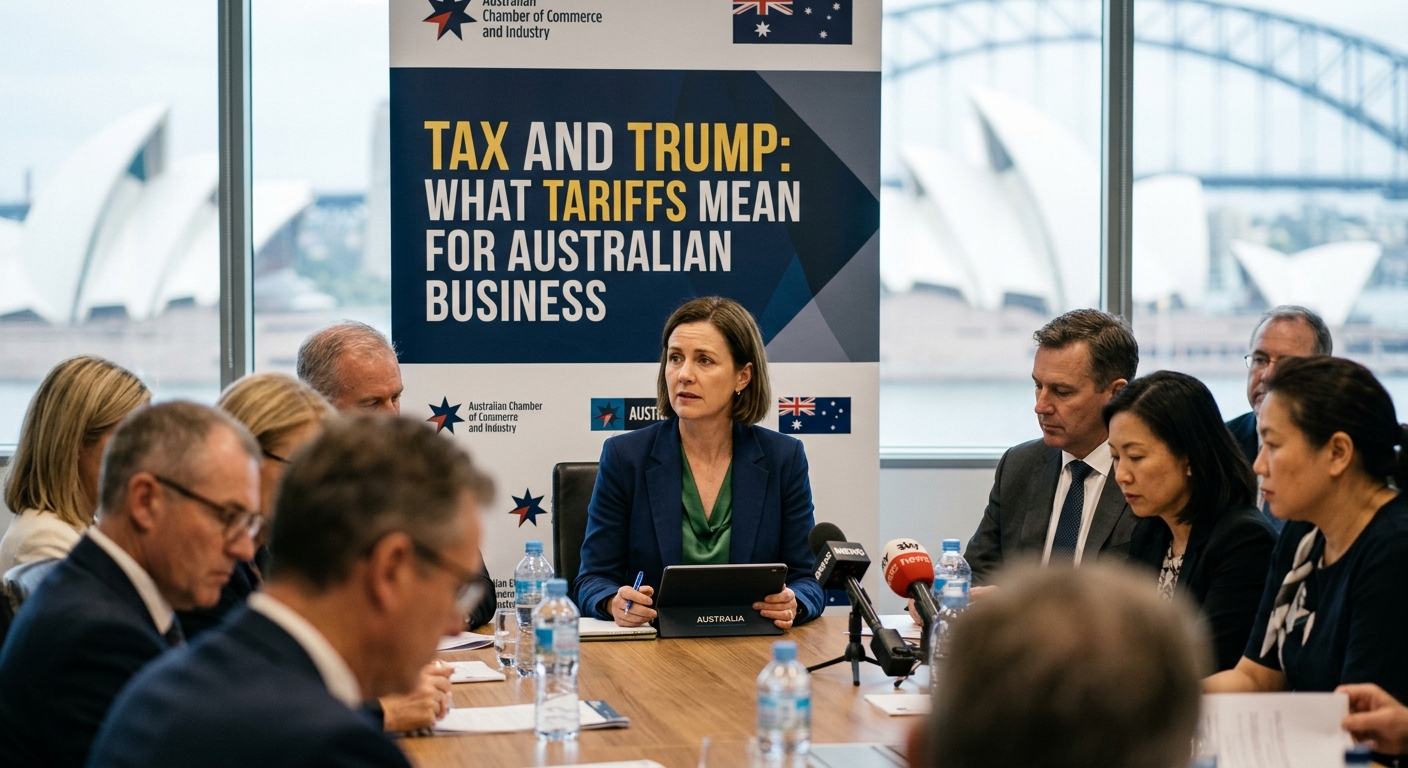
Trade policy and tax position are more connected than they look. Tariffs reshape supply chains, and reshaped supply chains reshape where profit is recognised and how transfer pricing is scrutinised.
For Australian businesses importing inputs or exporting to the US, the practical effect is a need to re-examine supplier concentration and contract terms — not panic, but planning.
We help clients model the through-flow: input cost pressure, margin impact, and any structuring (e.g. permanent establishment exposure) that suddenly matters more. The goal is decisions made on numbers, not headlines.
The Deeper Link Between Trade and Tax
The relationship between trade policy and tax position runs deeper than surface-level cost increases. When governments adjust tariff schedules, they alter the economics of cross-border commerce in ways that cascade through an enterprise’s entire operational footprint. For Australian enterprises engaged in international trade — particularly those with exposure to the United States market — these shifts demand more than reactive price adjustments. They require a structured reassessment of how value is created, where it is recognised, and whether the supporting documentation withstands heightened regulatory scrutiny.
A tariff is, at its core, a border tax. But its downstream effects migrate quickly into the domain of income tax, transfer pricing, and permanent establishment analysis. When a 25 per cent duty on steel imports forces a manufacturer to shift sourcing from China to Vietnam, the change is not merely logistical. It alters the contractual chain, the risk profile, the functional allocation of assets and people, and ultimately the arm’s-length pricing that underpins intercompany arrangements. Each of these elements sits squarely within the Australian Taxation Office’s compliance focus and, where US operations are involved, the Internal Revenue Service’s parallel regime.
Supply Chain Reconfiguration and Profit Attribution
Supply chain decisions made under tariff pressure often accelerate timelines that would otherwise span years. A business that relocates final assembly from a low-tariff jurisdiction to Australia to access preferential treatment under the Australia–United States Free Trade Agreement (AUSFTA) does not simply change a shipping address. It may create new functions, employ new personnel, deploy new assets, and assume new risks — each of which carries transfer pricing implications.
The OECD Transfer Pricing Guidelines, reflected in Australia’s Subdivision 815-B and 815-C of the Income Tax Assessment Act 1997, require that profits follow functions, assets, and risks. When those functions shift, the pricing model must shift with them. A distribution entity that previously earned a routine return may now bear inventory risk, manage complex logistics, or perform value-adding services. Its compensation must reflect that change. Conversely, if manufacturing moves offshore but strategic oversight remains in Sydney, the Australian entity may warrant a higher return — but only if the documentation substantiates the enhanced role.
Failure to align transfer pricing outcomes with the new operational reality invites audit attention. The ATO’s International Dealings Schedule (IDS) and Country-by-Country reporting obligations ensure that inconsistencies between supply chain structure and profit allocation are visible. The same holds true under the US Section 482 regulations and the IRS’s increased focus on transfer pricing documentation under Rev. Proc. 2021-39 and subsequent guidance.
Supplier Concentration and Contractual Resilience
For Australian importers, tariff volatility exposes the fragility of concentrated supply chains. A single-source dependency on a Chinese supplier for critical components becomes a strategic liability when duties escalate unpredictably. The response — dual-sourcing, near-shoring, or inventory buffering — each carries tax consequences.
Dual-sourcing introduces new intercompany or third-party contracts. If the alternative supplier is a related party, the pricing terms must satisfy the arm’s-length standard from day one. If the supplier is independent, the commercial terms — volume commitments, price adjustment mechanisms, force majeure provisions — affect the entity’s risk profile and, by extension, its transfer pricing characterisation. A distributor that absorbs tariff-driven cost increases without contractual pass-through mechanisms may see its margins compressed below the benchmark range, triggering IDS flags and potential audit enquiry.
Contract renegotiation is not merely a commercial exercise. The allocation of tariff risk between buyer and seller — whether through price escalation clauses, currency adjustments, or volume flexibility — shapes the functional analysis. An entity that bears tariff risk without corresponding control over sourcing decisions may be mischaracterised as a limited-risk distributor when its economic reality resembles a full-fledged entrepreneur. The inverse also holds: a manufacturer that contractually insulates its distributor from cost volatility may need to demonstrate that it retains the relevant decision-making functions to justify its higher return.
Input Cost Pressure and Margin Modelling
Tariffs operate as a non-negotiable cost overlay. Unlike exchange rate movements, which may be hedged, or labour costs, which may be managed through productivity, tariff costs are binary and policy-driven. They land directly on cost of goods sold, compressing gross margins unless passed through to customers — a prospect constrained by market elasticity, contractual rigidity, or competitive dynamics.
Modelling the through-flow of input cost pressure requires granular visibility. At the product level, which SKUs absorb the duty? At the entity level, which legal entity bears the customs liability? At the group level, how does the aggregate margin shift affect the group’s effective tax rate, its thin capitalisation position, or its eligibility for R&D tax incentives tied to Australian expenditure?
We work with clients to build scenario models that trace tariff exposure from the harmonised system code through to the consolidated income statement. The models incorporate customs valuation methodologies — transaction value, deductive value, computed value — and their interaction with transfer pricing policies. A transfer price that satisfies the ATO may not minimise customs duty; a customs valuation that minimises duty may distort the transfer pricing outcome. The intersection of these regimes demands integrated analysis, not siloed compliance.
Permanent Establishment Exposure in a Shifting Footprint
Structuring decisions made in response to trade policy can inadvertently create permanent establishment (PE) exposure. An Australian business that sends engineers to a US customer site to oversee installation of equipment — previously shipped directly from a third-country factory — may trigger a dependent agent PE under Article 5(5) of the Australia–US Tax Treaty if those personnel habitually exercise authority to conclude contracts. A warehouse leased in Texas to buffer inventory against port delays may constitute a fixed place of business PE under Article 5(1) if it exceeds the preparatory or auxiliary threshold.
The rise of digital business models compounds the risk. A SaaS provider that establishes a US-based customer success team to reduce churn may find its activities exceed the “preparatory and auxiliary” carve-out, particularly if the team negotiates renewals or upsells. The OECD’s Pillar One framework, while still evolving, signals a future where nexus rules decouple from physical presence altogether. Businesses that restructure today without modelling tomorrow’s PE landscape risk building liability into their new operating model.
We assist clients in mapping personnel movements, contractual authority, and facility usage against the treaty PE tests — both the current Australia–US treaty and the Multilateral Instrument (MLI) modifications that Australia has ratified. The analysis extends to state-level nexus in the US, where economic nexus standards post-South Dakota v. Wayfair mean that even without federal PE, a business may owe state income or franchise tax, sales tax, or gross receipts tax.
The Planning Imperative: Numbers, Not Headlines
Headlines amplify uncertainty. “Tariffs hit 60%” generates boardroom anxiety; “Our weighted average landed cost increases 4.2% under Scenario B, reducing Group EBITDA by $3.7 million, with a 1.3 percentage point effective tax rate impact” enables decision-making. The difference is analytical rigour.
Our engagement model centres on three phases. First, exposure mapping: identifying every tariff line, every supply chain node, every intercompany contract, and every personnel deployment that interacts with the changing trade regime. Second, quantitative modelling: simulating margin impact, cash flow timing, tax rate sensitivity, and PE risk under multiple tariff trajectories — baseline, escalation, retaliation, and negotiated settlement. Third, implementation planning: documenting transfer pricing policy updates, advancing pricing agreements (APAs) where warranted, renegotiating intercompany and third-party contracts, restructuring legal entity ownership or function to align with the new reality, and establishing monitoring triggers for ongoing compliance.
The output is not a static report. It is a living framework that finance, tax, supply chain, and legal teams can operate from — updated quarterly, stress-tested annually, and ready for regulator enquiry at any point.
Australian Context: Leveraging Treaty Networks and Domestic Incentives
Australia’s treaty network — 46 comprehensive agreements in force — provides planning flexibility that many jurisdictions lack. The Australia–US Treaty, the Australia–Japan Economic Partnership Agreement, the China–Australia Free Trade Agreement (ChAFTA), and the Comprehensive and Progressive Agreement for Trans-Pacific Partnership (CPTPP) each offer preferential tariff treatment contingent on rules of origin compliance. A supply chain redesign that qualifies goods for CPTPP preferential rates — by meeting regional